How to Choose a Testing Lab (Without Getting Burned)
Not all labs are created equal. Picking the wrong one can mean rejected test reports, wasted money, and shipments stuck at the border. Here's how to choose a compliance testing lab that regulators and retailers will actually accept.
- Not all testing labs are created equal — using a lab that isn't properly accredited for your regulation can mean rejected test reports, wasted money, and shipments stuck at the border
- The accreditations that matter most for US importers: ISO/IEC 17025, CPSC-Accepted (for children's products), and ILAC MRA signatory status
- Lab specialization matters as much as accreditation — a food safety lab and a children's product testing lab are completely different operations
- Always confirm a lab's scope of accreditation for your specific test standards before sending samples
You've done everything right. You found a lab, sent your samples, waited three weeks for results, and got a clean test report. You attach it to your Children's Product Certificate, file your paperwork, and ship the container. Then customs flags the shipment. The lab you used isn't on CPSC's accepted list for the standard you tested to. Your test report is worthless. You're starting over — with a different lab, new samples, and another three-week wait while your goods sit in a warehouse burning storage fees.
This happens more often than you'd think. And it's almost always preventable.
Choosing a compliance testing lab isn't complicated, but it does require more diligence than googling "product testing lab near me" and going with whoever answers the phone first. The lab you pick needs to be accredited for the right standards, experienced with your product category, and capable of producing reports that regulators and retailers will actually accept. Here's how to make sure you get it right.
Why lab choice matters more than you think
If you're importing consumer products into the US, third-party testing isn't optional for most categories. CPSIA requires it for children's products. California's Prop 65 practically demands it if you want to prove your products are below safe harbor levels. PFAS rules and customer requests are increasingly driving testing. And if you're in the food space, FDA expects supplier verification activities, which can include sampling and testing (21 CFR 1.506).
The catch is that not just any lab will do. Regulators, customs authorities, and major retailers all have expectations about which labs they'll accept reports from. A test report from a non-accredited lab is, from a compliance standpoint, barely better than no test report at all.
Here's what's at stake when you choose the wrong third-party testing lab:
- Rejected test reports. A children's product certificate must be based on testing by a lab CPSC has accepted for that rule (16 CFR 1112); results from any other lab don't count. You'll need to retest with an accepted lab, doubling your cost and timeline.
- Customs holds. If your compliance documentation references testing from a lab that doesn't meet the relevant accreditation requirements, customs can flag and hold your shipment.
- Retailer rejections. Major retailers often run their own vendor compliance programs, and a report from an unfamiliar lab can trigger additional scrutiny or outright rejection.
- Legal exposure. If a product safety issue arises and your testing was done by a lab without proper accreditation, your legal position gets significantly weaker.
The cost difference between a reputable accredited lab and a questionable one is often modest. The cost of choosing wrong can be far higher.
Key accreditations to look for
Not all accreditations are equal, and the ones that matter depend on what you're importing. Here are the three that come up most often for US importers.
ISO/IEC 17025. This is the international standard for testing and calibration laboratories. It's the baseline. If a product testing laboratory doesn't have ISO 17025 accreditation, stop the conversation there. This standard means the lab has been independently audited for technical competence, has quality management systems in place, and produces reliable, reproducible results. It's not a guarantee of perfection, but it's the minimum threshold for any serious compliance testing.
CPSC-Accepted. If you're importing children's products, this one is non-negotiable. The Consumer Product Safety Commission maintains a list of CPSC accepted labs that can test for specific CPSIA standards — things like lead in paint (16 CFR 1303), total lead content, phthalates (16 CFR 1307), and toy safety (ASTM F963). A lab can be ISO 17025 accredited but still not be on CPSC's accepted list for the specific standard you need. Always check both. CPSC publishes its accepted lab list, with each lab's accepted scope, at cpsc.gov.
ILAC MRA. The International Laboratory Accreditation Cooperation Mutual Recognition Arrangement is relevant when you're using labs overseas — particularly in China, Vietnam, or other manufacturing countries. For CPSC acceptance, a lab's ISO/IEC 17025 accreditation must come from an accreditation body that is an ILAC-MRA signatory (16 CFR 1112.13). This matters because testing at the source (near your factory) is often faster and cheaper than shipping samples to the US for testing.
A few other accreditations you might see: A2LA (American Association for Laboratory Accreditation) and NVLAP (National Voluntary Laboratory Accreditation Program) are both US-based accreditation bodies that assess labs against ISO 17025. Seeing either of these on a lab's credentials is a good sign.
Specialization matters: not all labs test all things
Here's something that trips up first-time importers: a lab can be fully accredited and still be completely wrong for your product. Accreditation is granted for specific test methods and scopes, not as a blanket endorsement of everything a lab might do.
Think of it like doctors. A cardiologist and a dermatologist are both board-certified physicians, but you wouldn't ask your dermatologist to interpret your echocardiogram. Testing labs work the same way.
The major specialization areas for US import compliance:
- Children's products and toys. Testing for lead, phthalates, flammability, small parts, mechanical hazards (ASTM F963), and tracking labels. Labs like ACT Lab, Intertek, and SGS work in this area.
- Food safety and contact materials. FDA compliance, food contact material testing, microbiological analysis, nutritional labeling verification. Eurofins is one of the labs active in this space.
- Chemical analysis. Prop 65 testing for listed chemicals, heavy metals, VOCs. This overlaps with children's product testing but extends to any consumer product sold in California.
- PFAS testing. Increasingly important and highly specialized. Targeted testing typically uses LC-MS/MS to detect per- and polyfluoroalkyl substances at very low levels, and the right method depends on the material. Pace Analytical and Eurofins both offer PFAS testing.
- Electronics and electrical safety. UL certification, FCC compliance, electrical safety standards. UL Solutions and TUV Rheinland are well-known names.
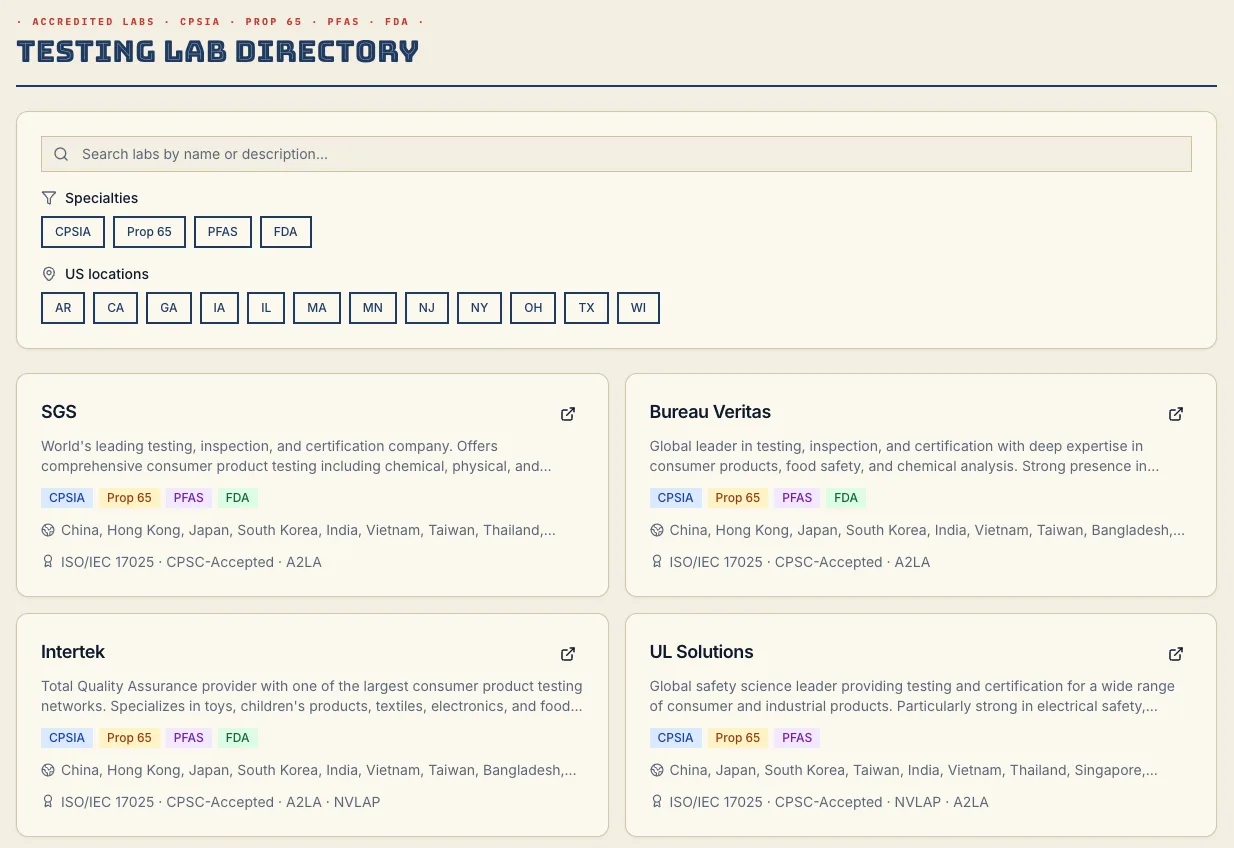
When evaluating a lab, don't just ask "are you accredited?" Ask "are you accredited for the specific test methods I need?" A lab that's brilliant at food safety testing might have zero capability for children's product testing, and vice versa.
Aleph keeps each product's lab reports and certificates on file against the product, with the testing requirements cited — you choose the lab and confirm its acceptance on CPSC's list. See how it works →
Domestic vs. international labs
One of the first decisions you'll face is whether to test domestically (in the US) or at a lab near your manufacturing source (typically China, Vietnam, India, or Bangladesh). Both approaches work, but they have different trade-offs.
Testing at source (international labs):
- Faster turnaround — samples don't need to be shipped internationally
- Lower cost — lab rates near manufacturing hubs are often lower than US equivalents
- Proximity to factory — easier to coordinate sample pulls and retesting
- Timezone challenges — communication can lag if issues come up mid-test
- Accreditation verification — you need to confirm the lab's ILAC MRA status and CPSC acceptance (many Asian labs are on the list, but not all)
Testing domestically (US labs):
- Familiarity — easier to verify accreditations, visit the lab, build a relationship
- Communication — same timezone, same language (usually), faster responses
- Sample shipping time — adds time before testing even starts
- Higher cost — US lab rates tend to be higher
- Retailer preference — some retailers prefer or require US-based testing
Several major international lab networks — such as SGS, Intertek, Bureau Veritas, and TUV Rheinland — have facilities in both the US and Asia. Many importers use the same lab network but different locations depending on the product — initial testing at the factory, follow-up or verification testing domestically.
Questions to ask before choosing a lab
Before you commit to a third-party testing lab, run through this checklist. It'll save you from the most common mistakes.
Accreditation and scope:
- Are you ISO/IEC 17025 accredited?
- Are you CPSC-accepted for [specific standard, e.g., ASTM F963, 16 CFR 1303]? (children's products only)
- Is your accreditation body an ILAC MRA signatory? (international labs only)
- Can I see your current scope of accreditation? (it should list specific test methods)
Experience and capability:
- How many [product category] tests do you run per year?
- Do you have experience with [specific regulation — CPSIA, Prop 65, PFAS, FDA]?
- Can you test to [specific standard — ASTM F963, the Prop 65 chemicals you need, a specific PFAS method]?
Logistics and turnaround:
- What's your standard turnaround time for [test type]?
- Do you offer rush testing? What's the premium?
- How do I submit samples? What quantity do you need?
- Do you pick up samples from the factory, or do I need to ship them to you?
Reports and documentation:
- Do your test reports include all fields required for a CPC / Prop 65 disclosure / PFAS report?
- Can you provide reports in a format that [retailer name] accepts?
- Do you offer digital report delivery, or is it paper-based?
Pricing:
- What's your per-test pricing for [specific tests]?
- Do you offer package pricing for multiple tests on the same product?
- What happens if a test fails — is retesting included, or is it an additional charge?
- Do you have minimum order requirements?
If a lab can't answer these questions clearly and quickly, that tells you something about how organized they are — and how organized your test reports will be.
What testing actually costs
Testing costs vary enormously depending on the product category, the number of tests required, and the lab you choose. Here are rough, illustrative ranges to give you a sense of scale — they are not quotes, and current prices vary by lab and region:
- CPSIA children's product testing (lead, phthalates, ASTM F963): $500–$2,500 per SKU depending on component count and test scope
- Prop 65 chemical testing (specific listed chemicals): $200–$1,000 per chemical group
- PFAS testing (method depends on the material): $300–$800 per sample
- Food contact material testing: $500–$2,000 depending on material type and test scope
A few cost considerations that catch importers off guard:
Component-level testing. For children's products, each accessible component may need separate testing. A toy with 8 different materials could require 8 separate lead tests. Costs add up fast.
Retesting fees. If a product fails initial testing, you'll likely need to retest after making changes. Many labs charge full price for retests. Some offer discounted retesting within a window — ask upfront.
Rush premiums. Standard turnaround varies by test and lab, and rush testing usually carries a significant premium. Ask for both up front and plan ahead when you can.
Package deals. If you're testing multiple SKUs or need ongoing testing, ask about volume pricing. Many labs will negotiate on rates for repeat business.
Major accredited labs worth knowing
The product testing laboratory landscape has a few tiers. At the top are the global full-service companies that handle everything from food safety to toy testing. Below them are specialized labs that focus on specific niches. The notes below are general background, not endorsements; CPSC acceptance is granted per lab location and per rule, so check the specific location on CPSC's list and the lab's current scope of accreditation.
Full-service global labs (CPSIA + Prop 65 + PFAS + FDA capable):
- SGS — One of the largest testing companies, with US facilities and labs in major Asian manufacturing cities.
- Intertek — Large consumer product testing network with US and Asian locations. Active in toys and children's products.
- Bureau Veritas — Global testing, inspection, and certification company with US labs. Active in softlines and hardlines testing.
- UL Solutions — Safety science company headquartered in Illinois. Known for electrical safety, flammability, and chemical testing.
Specialized and regional labs:
- TUV Rheinland — German-based, with toy safety and consumer electronics testing and US labs.
- Eurofins — Large global lab network. Offers food safety, PFAS analysis, and environmental testing, with US labs.
- QIMA — Focused on supply chain quality, with inspection and lab services across Asian manufacturing hubs and online booking. Worth a look if your manufacturing is in China or Southeast Asia.
- ACT Lab — Focused on children's products and toy testing.
- Pace Analytical — US environmental testing network that offers PFAS testing.
- Element Materials Technology — Analytical chemistry for Prop 65, PFAS, and materials characterization, with US labs.
You don't need to pick just one lab. Many importers work with two or three — one for their primary product testing, another for specialized tests (like PFAS), and sometimes a third at the factory location for pre-shipment verification.
How Aleph helps with testing and tracking
Choosing the right lab is step one. Keeping track of everything that comes after — test reports, certificate expiry dates, which SKUs need retesting, which lab tested what — is where things get messy fast. It's the same spreadsheet problem that plagues every part of import compliance.
Once you've completed testing, Aleph connects your test reports to your products. It keeps your test reports and CPC documents on each product, emails you before the expiry dates you record, and keeps all your compliance records organized — so you're not hunting through email threads when a retailer or customs agent asks for documentation. That's why we built it.
You can try it on two products for free — start free, no card required.
Practical next steps
If you're evaluating testing labs right now, here's a concrete path forward:
- List your testing needs. Write down every regulation that applies to your products — CPSIA, Prop 65, PFAS, FDA, whatever. For each one, identify the specific test standards required.
- Check accreditation first. Before talking pricing or turnaround, verify that any lab you're considering is properly accredited for your specific test standards. For children's products, check the CPSC accepted lab list.
- Get quotes from 2-3 labs. Pricing varies more than you'd expect. Get quotes from at least two labs — preferably one domestic and one at your manufacturing source — and compare not just price but turnaround time and what's included.
- Ask about report format. Make sure the test report will include everything you need for your compliance documentation — whether that's a CPC, a Prop 65 disclosure, or a PFAS report. The last thing you want is a passing test result that's missing a required field.
- Build a relationship. Once you find a lab that works well, stick with them. Repeat clients get better service, faster turnaround, and sometimes better pricing. Your lab is a compliance partner, not just a vendor.
Testing is one of those things that feels like pure cost until the day it saves you from a recall, a customs hold, or a lawsuit. The lab you choose is the foundation your entire compliance program sits on. It's worth getting right.
- Always verify a lab's accreditation for your specific test standards before sending samples — ISO 17025 is the minimum, CPSC acceptance is required for children's products
- Lab specialization matters as much as accreditation — match the lab's expertise to your product category and regulation
- Get quotes from multiple labs, ask about retesting policies and rush pricing upfront, and build a long-term relationship with the lab that delivers reliable results
Keep every lab report with its product
Once you've picked a lab, Aleph keeps your test reports and certificates in one place, filed against the products they cover.
Get Started